
Inside the AI Hype Cycle
The User Viewpoint

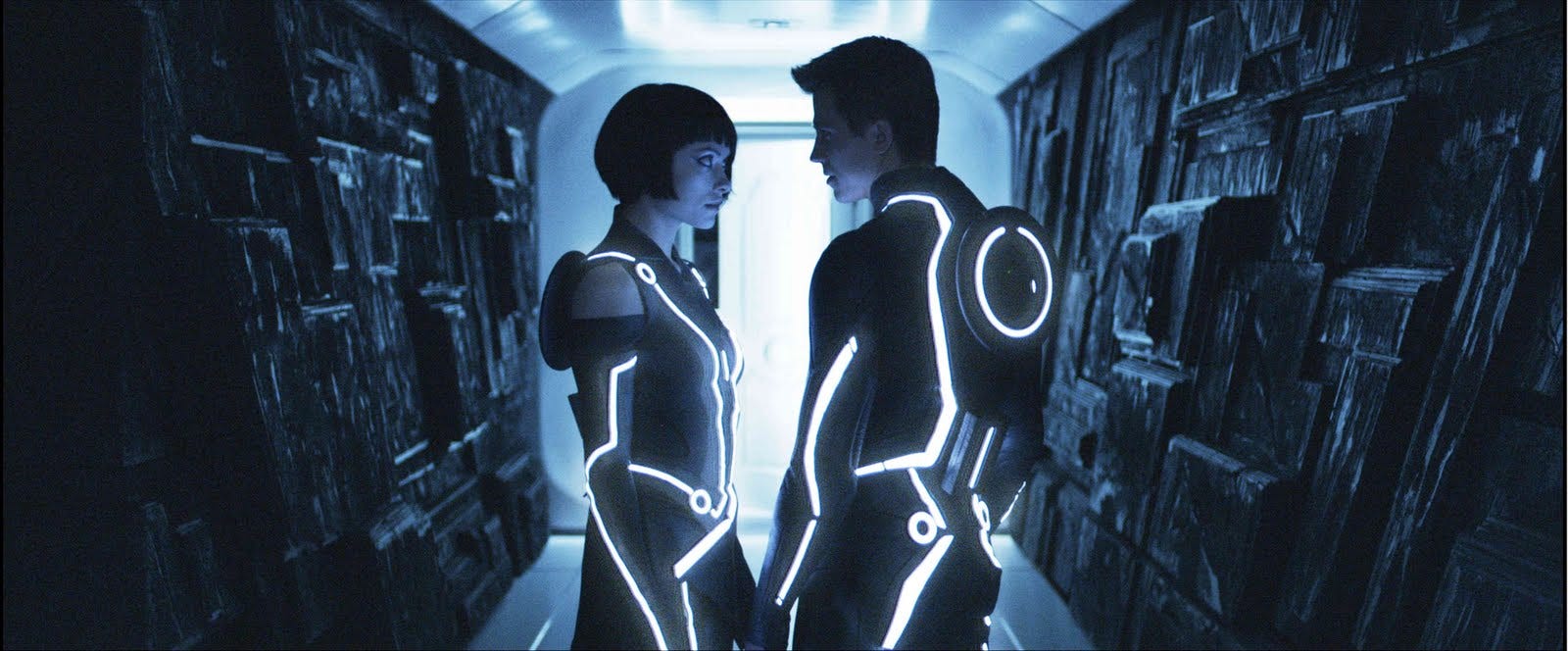
The Grid. A digital frontier. I tried to picture clusters of information as they moved through the computer. What did they look like? Ships? motorcycles? I kept dreaming of a world I thought I'd never see….
Recently I’ve been thinking about what it feels like to be a USER of digital products today. Despite the increasingly breathless hype around artificial intelligence, I’ve found myself struggling to feel passionate about some of these new products. Why? And what might need to change?
Peak/trough
At a recent dinner with founders I asked what AI products they found most exciting as USERS. I didn’t want to hear what companies VCs found exciting as potential investments, or what CEOs were interested to deploy into their orgs. But instead wanted to hear about the cutting edge products that people in San Francisco were using, whether for work or in their personal lives. What were the most exciting products that might suggest something about the potential for this technology?
I was surprised when we could only agree on a few examples.
It didn’t feel like the reason was a lack of awareness – this was a group of founders based in San Francisco who were actively looking at tools for their businesses, and had already tried a broad range of different products.
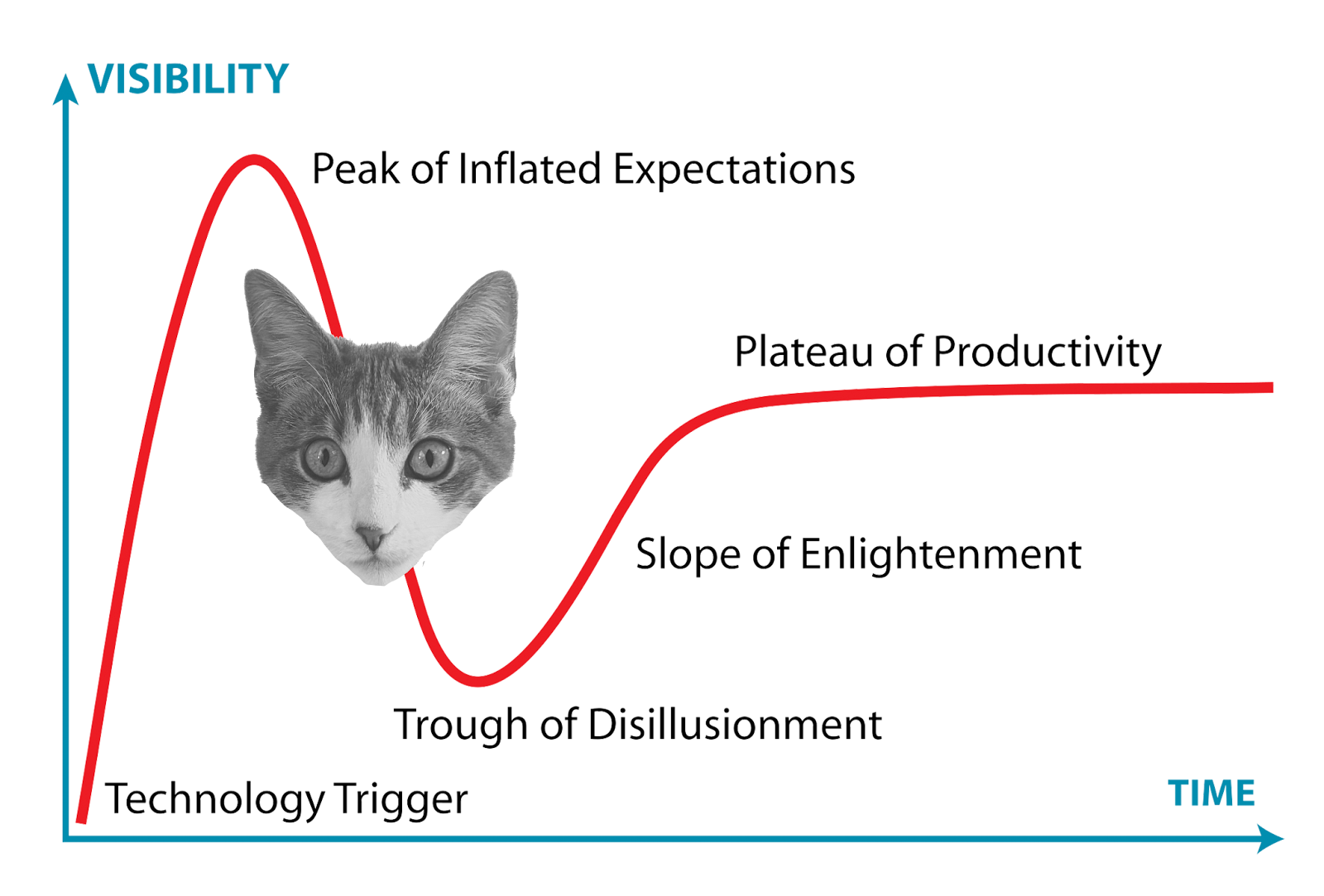
It seems like today we’re simultaneously straddling the peak and trough of the Hype Cycle. A sort of Schrodinger’s cat of hype and disillusionment.
On one hand venture funding for AI companies is at an all time high, and has now reached more than 30% of all VC dollars (Q3 2024). Many of the companies that I spend time with day to day are positioning themselves to use AI to deliver their product solution.
And on the other hand, model progress at the large LLM labs seems to be slowing, and the amount of money and energy required to make incremental developments is growing. The amount of VC dollars flowing into the space have raised expectations, possibly unreasonably. And what people around that dinner table were telling me was that product development is still nascent.
Before we dive into why end USERS are often finding those experiences unfulfilling, I want to reflect on what I might have been expecting by taking a trip down memory lane…
Remembering the Future
I’ve been reflecting on my memories of using new technology for the first time. Partially as a fun exercise in nostalgia, and partly as a way of benchmarking how I’m feeling now.
I specifically recall using the internet for the first time when I was 7 or 8 years old. I had to borrow my dad’s work laptop (since there was no computer in the house otherwise) and used a slow dial up connection to research a history assignment on the Roman Empire. Hadrian’s wall, the layout of a centurion’s camp, roman aqueducts – all good stuff. I’m guessing it was pages from the online Encyclopedia Britannica (?), but it could have been something else. I remember being viscerally amazed that all of this content was available, without the limitations of my teacher or the few history books on the bookshelf at home.
Later… I recall the first video games I owned and played (including of course the timeless Age of Empires). Later my first iPod, Photoshop, Google Earth, a detour into Sebelius (a music creation software), then through to Uber, Google Docs, Slack. More recently the technologies that I can’t get enough of include the latest MacBook with Apple Silicon, Find My (friends and objects), Partiful, Superhuman and the automatic litter box that we just bought for our cat.
Each of these things felt (to a greater or lesser extent) seismic and memorable. And as a USER it seemed obvious that we were on a one way street. Why would I ever want to go back to the days before any of these innovations? It wasn’t just that they did some specific task for me more efficiently, they fundamentally changed the way in which I led my life and carried out my work. It was clear that this was the future. And in this future I don’t scoop cat poop.
Why is it that my dinner guests didn’t have a longer list of experiences to share that they were excited about?
Some suggestions of where we lost our way
Here’s a few ideas for why USER experiences that utilize AI are still lagging behind the hype:
Is it still too early? The most simplistic argument is that the technology is still early, and we need to wait for further developments. But I find that argument slightly unfulfilling. Some of the technical capabilities of these tools are already strong – and I believe you should already be able to build some pretty compelling products using what we have today.
Chat is a bad UX. There I said it. I just don’t think that a chat interface is the answer. Same goes for voice. There will sometimes be a place for being able to fire of a quick question or action. But for many, many experiences chat or voice are incredibly limiting. Simply put it’s just a lot better to be able to see and interact with information in a visual form. Graphical User Interfaces (GUIs) are not going away.
Hallucination fatigue. If you buy a new red car, you’ll suddenly notice matching cars everywhere. Likewise we’re now hyper aware of any error that AI tools make, and given high expectations, any errors quickly become disqualifying. The underlying architecture of these technologies mean that it’s usually not possible to understand exactly what is driving certain responses. I worry that we might be driving off the cliff, with nobody trusting anything AI generated.
Computer says no. The flip side is that many product teams have been forced to set strict rules and parameters on the AI models they’re using. Unfortunately this creates another problem, where the model is limited to a set of standard responses, and cannot go outside of a well-defined range of topics. When users get stuck in recursive loops, or end up needing to be directed to a human, then we’ve built nothing better than what we already had, but spent a whole lot more money getting there.
Sloppy implementations. Unfortunately there are also a ton of sloppy and annoying implementations of AI experiences, which is rapidly burning customer goodwill. Too many companies are publicly playing around with AI and getting egg on their faces.
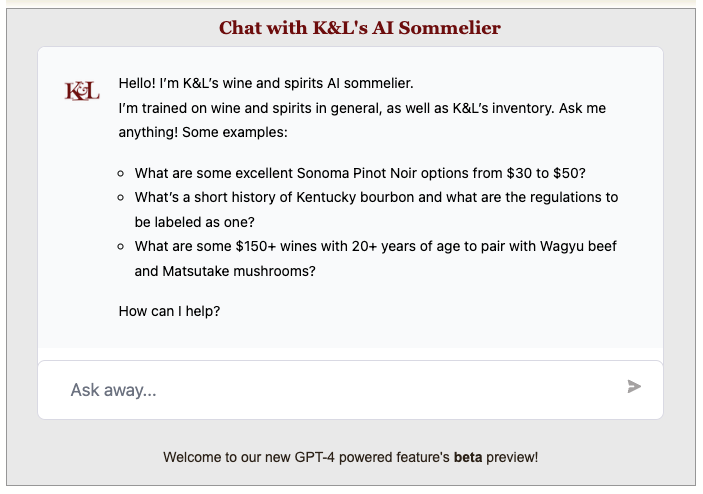
Here’s a small but indictive recent example. K&L is a pretty well respected wine merchant in California. They have a wide selection, friendly and knowledgeable staff, and a website that looks like it hasn’t been updated since the early 2000s with long form human reviews of recent shipments. (I like this). Last time I vistied their website I noticed they had shipped an “AI Sommelier” product to their home page. It’s an interesting concept, and I can imagine a version of this product that might be nicely implemented. Unfortunately this is not that.From a product marketing point of view I find the reference to “GPT-4” and “beta” to be irrelevant (and off-putting)
From a UX point of view chat is a horrible choice – if you are selecting wines I want to be able to compare different bottles (including see images of the bottles), create a shopping cart, and then go to checkout. In fact there isn’t really a choice being made here, this is literally just GPT-4 in a box on their homepage.
To add further insult to injury this thing is absolutely useless and recommended I buy 5 bottles of sparkling wine for a dinner where I was serving roast lamb, and refused to stick to my budget.
Just don’t do this. If you can’t do something that is at least good, but ideally amazing – do nothing.
I fight for the users
It feels unwise to make too many predictions about what happens over the next few years. Some are predicting a coming AI winter, while others are confident that progress will accelerate, and we will reach AGI. I’m a realist so my money is on a sort of middle ground.
However, what I do feel confident in predicting is that products that will be best positioned will be designed with the USER in mind first and foremost and will help that them solve specific problems they face in the real world.
Building magical products isn’t meant to be easy! Nonetheless here’s some guidance for founders and teams building products using AI:
Admit that you’re not actually an AI company – Companies should either be in one of two camps. On one hand true “picks and shovels” Artificial Intelligence companies, working at the cutting edge of computer science. And on the other side product companies building products for USERS. I’m happy to admit that I don’t know enough to invest in Group 1 companies, but it seems obvious that these companies must believe they can offer a unique pick or shovel to OpenAI, Google, Facebook, Anthropic, Microsoft etc… or will be directly competing with one, or all, of these players. For founders building products for USERS my advice is simple – admit you’re not an AI company. You’re a product company that builds with technology. One of the technologies you use is LLMs/ AI, alongside cloud, mobile, hardware sensors or whatever. You need to have enough expertise in your company to leverage the benefits – but not enough that the tail starts wagging the dog.
Opinionated design and experience – I believe we became lazy designers over the past decade. Design isn’t an optimization game, but about ingesting inputs such as user needs, and then having a strong point of view and a sense of taste to create something that does what it says… while also making you feel something. Too many products look the same. Let’s bring back opinionated products.
Skeuomorphism was a design language to help users adapt to mobile using metaphors that recalled physical objects. What will the skeuomorphism for tools that leverage AI look like?
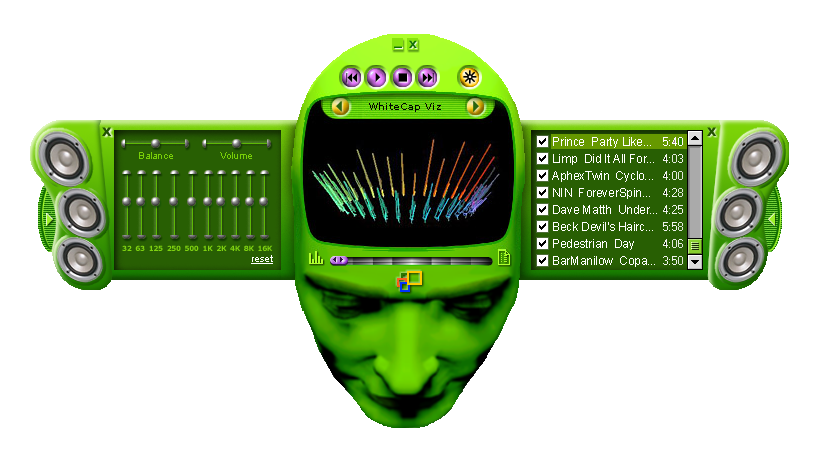
Brand – brand is the flashy cousin of design. Lots of clever people agree that the price of software development is trending towards zero. And in that world your brand becomes a uniquely differentiating point. I want to be entertained, intrigued and surprised! And I think that’s true not just for consumer businesses – if you sell to other companies you should believe in something and tell a story with your brand too.
Software, software, software – good software works! And AI isn’t a panacea. I believe the best products will have a software skeleton with some organs powered by AI. An AI skeleton is like having jelly for bones.

Integrations and connectivity. In the future, your unique connectivity, data and integrations will become the way to stand out from competitors. If there’s a million different AI tools to track your fitness, a product with a bespoke integration with a specific gym chain, health sensor or from another unique data source will be much more immune to changes to underlying AI technology.
AI that’s invisible is the best AI. AI is more like the Cloud, than it is like Mobile. By that I mean – USERS mostly don’t give a F. As soon as companies realize this the better. End customers (whether business or consumer) want to do X, Y and Z. The means to that end is usually not terribly important. And for now at least, the vagaries of LLMs are best disguised and shepherded along by other pieces of software, rather than exposed, warts and all, to the end USER.
Give your product a diet. Too many products being built today are overly broad. The best products are specific and focused, and only later become broader over time. Just because the underlying technology (e.g. LLMs) can be made to do anything, doesn’t mean that your product should. I want to see more companies taking really narrow problems, and building incredibly specific solutions that leverage just enough AI to deliver something interesting.
Distribution. Let’s not forget that the product itself is not all of a business. In particular, distribution is critical – how you sell your product to users is not just a determiner of success, but in some way part of the product itself. Finding customers where they are, including in non-online spaces, or even creating new markets that didn’t exist before.
If the above resonates with you or if you’re building software / products with a strong user focus I’d love to chat.
I invest through Capital 49, a new venture fund that invests in early stage businesses and has recently backed businesses like 11x.ai and Kintsugi. And I was previously an early member of the team at Monzo.